Un ancrage pour se redonner le choix
Under pressure, our brain replays old responses learned in the past.
This helps us act quickly. But it can also activate defensive patterns (fight/flight/freeze) that are no longer appropriate today.
Sensory anchoring allows you to voluntarily return to a safer inner state (clarity, calm, stability, feeling of control).
It is a tool for the present moment.
It does not "fix" the root cause on its own—but it creates the space necessary to choose your response.
Why anchoring works
The brain loves associations.
When two things happen together repeatedly—a gesture and a positive inner state—the brain begins to connect them. With practice, the gesture alone is enough to reactivate the state.
Two mechanisms reinforce this effect:
1. The association
You associate a gesture with a truly positive experience until the brain learns the connection.
(This is associative learning.)
2. Mental imagery
You relive a real moment through your senses.
Seeing the scene, hearing the sounds, feeling the body is enough to reactivate the corresponding emotion.
(This is mental imagery.)
As with any skill:
what you practice gets stronger; what you don't practice fades away.
Anchors can also be context-dependent.
It is therefore useful to practice in several environments (office, meeting room, home, videoconference) so that the anchor works everywhere.
Step-by-step protocol
Objective:
To link a discreet and unusual gesture to a memory rich in well-being and inner stability.
1. Choosing the right souvenir
A real moment when you felt completely at ease, calm, and in control of the situation.
The more positive and vivid the memory, the better.
2. Choose the gesture
Discreet and non-automatic:
pinch your thumb and middle finger,
tap a specific point on the wrist,
Lightly place your hand on the sternum.
3. Reliving with the senses (multisensory imagery)
Close your eyes for 30 to 60 seconds.
See the light, the colors, the faces.
Hear the sounds, the voices, the music.
Feel your posture, temperature, breathing, and the release of tension.
Add odors or tastes if present.
Let the pleasant sensation rise through your body.
4. Locate the activation window
The feeling is building; you sense that it will intensify slightly.
This is the right moment —on the rise, just before the peak.
5. Anchor
At that precise moment, make the gesture and press down a little harder, as if you were "imprinting" the emotion on the body.
6. Breaking the state
Open your eyes or think about something else for 10 to 15 seconds
(for example, a neutral item on your to-do list).
7. Test
Just repeat the movement.
Does the state return (images, sounds, bodily sensations)?
If so: perfect.
If not: choose a richer memory or make the gesture clearer.
8. Strengthen
Practice for 1 to 3 minutes a day, for 2 to 3 weeks, in various contexts.
Then, do light reminders (weekly → monthly).
An unused anchor weakens.
A trained anchor becomes easier and easier to activate.
👉 Grounding does not replace the underlying work.
But it calms the reflex, restores an immediate sense of security, and gives you back access to what matters most: the ability to choose your response.
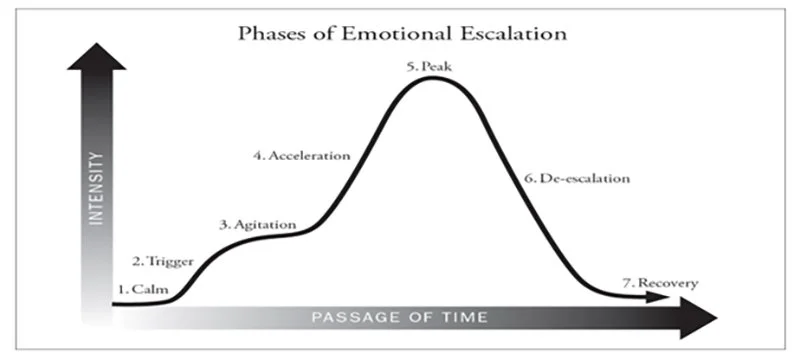
Emotional phases: Calm, Stimuli, Agitation, Acceleration, Peak, Descent, Recovery
Good to know
If the emotion of the moment is more intense than your anchor, it can override it.
In this case, it is possible to create one or more more "energetic" anchors to deal with highly emotional situations.Anchoring regulates the present state; it does not, on its own, transform deep-seated defensive patterns.
It is possible to stack several sensations on the same anchor: if the emotional states are sufficiently similar, they can merge and act together.
For deeper patterns: how IFS can help
When the same reactions come up again and again—tensing up, losing your temper, shutting down—it is likely that a protective part is taking control to avoid deeper emotional pain.
The Inner Family System (IFS) allows you to:
Identify the protective parts and the wounded parts they are trying to protect.
Safely revisit past situations and update them with new information and experiences.
Implement new responses that are adapted to today's reality.
In simple terms:
IFS creates the optimal conditions for memory flexibility.
When a memory is reactivated, there is a short window during which what has been learned can be revised (a process often referred to as reconsolidation).
IFS transforms these neuroscientific principles into a clear, respectful, and deeply human process for growth—as a leader and as a person.
What can we do in practical terms?
Create your personalized anchor
We can work together to design powerful, effective anchors tailored to your needs, while respecting your inner balance and personal ecology.
Going deeper with IFS
Through IFS coaching, we can transform recurring defensive responses into new ways of being that are better aligned with your current environment—in a safe, compassionate, and respectful setting.
👉 If you would like support in building your foundation or reworking the deeper map, please don't hesitate to contact me.